 jobdiv.com
 Registered Nurses (RNs) have a broader scope of practice and typically perform more complex medical tasks than Licensed Practical Nurses (LPNs), including patient assessments and creating care plans. LPNs provide essential bedside care and monitor patient health under the supervision of RNs or physicians, making them crucial for daily patient support. Both roles require specific licensure and contribute significantly to healthcare teams with distinct responsibilities.
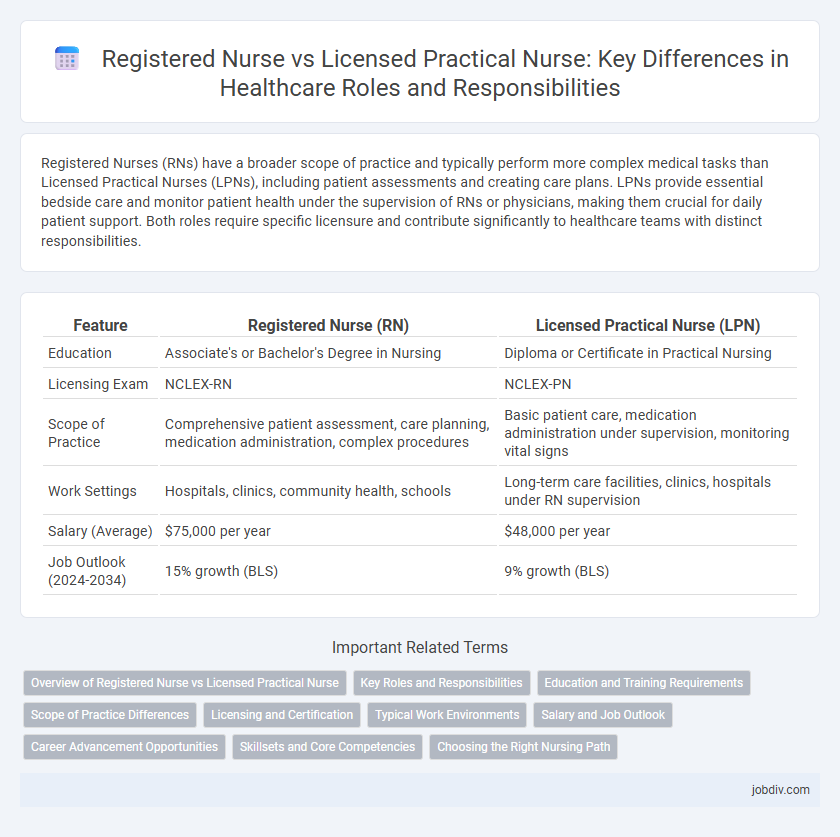
Table of Comparison
| Feature | Registered Nurse (RN) | Licensed Practical Nurse (LPN) |
|---|---|---|
| Education | Associate's or Bachelor's Degree in Nursing | Diploma or Certificate in Practical Nursing |
| Licensing Exam | NCLEX-RN | NCLEX-PN |
| Scope of Practice | Comprehensive patient assessment, care planning, medication administration, complex procedures | Basic patient care, medication administration under supervision, monitoring vital signs |
| Work Settings | Hospitals, clinics, community health, schools | Long-term care facilities, clinics, hospitals under RN supervision |
| Salary (Average) | $75,000 per year | $48,000 per year |
| Job Outlook (2024-2034) | 15% growth (BLS) | 9% growth (BLS) |
Overview of Registered Nurse vs Licensed Practical Nurse
Registered Nurses (RNs) typically hold a Bachelor of Science in Nursing (BSN) and have broader responsibilities including patient assessments, care planning, and administering complex treatments, while Licensed Practical Nurses (LPNs) usually complete a one-year diploma and provide basic nursing care under RN supervision. RNs possess greater clinical autonomy and can specialize in various healthcare fields, making them essential in diverse medical settings such as hospitals and clinics. LPNs support RNs by monitoring vital signs, wound care, and assisting with daily patient activities, serving as a crucial link in the continuum of care.
Key Roles and Responsibilities
Registered Nurses (RNs) perform comprehensive patient assessments, develop and implement care plans, and administer a wide range of medications and treatments, often supervising Licensed Practical Nurses (LPNs) and other healthcare staff. Licensed Practical Nurses provide basic nursing care, such as monitoring vital signs, assisting with daily living activities, and administering certain medications under the supervision of RNs or physicians. Both roles are essential in delivering effective healthcare, with RNs typically handling more complex clinical tasks and LPNs focusing on fundamental patient care.
Education and Training Requirements
Registered Nurses (RNs) typically complete a Bachelor of Science in Nursing (BSN) or an Associate Degree in Nursing (ADN), with programs lasting between 2 to 4 years and including comprehensive clinical training. Licensed Practical Nurses (LPNs) undergo a shorter training period, usually a one-year diploma or certificate program centered on basic nursing skills and patient care. RNs must also pass the NCLEX-RN exam, whereas LPNs are required to pass the NCLEX-PN exam to obtain licensure.
Scope of Practice Differences
Registered Nurses (RNs) possess a broader scope of practice, including comprehensive patient assessments, developing and managing nursing care plans, and administering complex treatments. Licensed Practical Nurses (LPNs) typically provide basic nursing care, monitor patient vital signs, and assist with daily activities under the supervision of RNs or physicians. RNs have the authority to perform advanced clinical procedures and contribute to patient education, while LPNs focus primarily on routine care tasks within established protocols.
Licensing and Certification
Registered Nurses (RNs) obtain a nursing license by passing the National Council Licensure Examination for Registered Nurses (NCLEX-RN), which requires completion of an accredited nursing program typically lasting two to four years. Licensed Practical Nurses (LPNs) earn licensure by passing the National Council Licensure Examination for Practical Nurses (NCLEX-PN) after completing a practical nursing diploma or certificate program, usually about one year in length. Certification requirements for both roles vary by state but generally include maintaining licensure through continuing education and meeting renewal criteria set by the state nursing board.
Typical Work Environments
Registered Nurses (RNs) commonly work in diverse settings such as hospitals, outpatient clinics, nursing homes, and community health centers, where they provide comprehensive patient care and coordinate treatment plans. Licensed Practical Nurses (LPNs) typically perform their duties in long-term care facilities, assisted living centers, and home healthcare environments, focusing on basic nursing care under the supervision of RNs or physicians. Both roles are integral to patient care, but the complexity and scope of work environments reflect the differences in training and responsibilities between RNs and LPNs.
Salary and Job Outlook
Registered Nurses (RNs) typically earn a median annual salary of around $77,600, significantly higher than Licensed Practical Nurses (LPNs), who average about $48,070 per year. The job outlook for RNs is projected to grow 9% from 2022 to 2032, reflecting strong demand in healthcare settings, while LPN employment is expected to grow by 6%, also indicating steady opportunities but at a slower pace. Higher educational requirements and broader clinical responsibilities contribute to the more favorable salary and job growth prospects for RNs compared to LPNs.
Career Advancement Opportunities
Registered Nurses (RNs) have greater career advancement opportunities compared to Licensed Practical Nurses (LPNs) due to their higher level of education and broader scope of practice. RNs can pursue specialized roles such as nurse practitioner, clinical nurse specialist, or nurse educator, often requiring a Bachelor of Science in Nursing (BSN) or higher. LPNs typically have more limited options for advancement, frequently advancing through additional certifications or transitioning to RN programs for expanded career paths.
Skillsets and Core Competencies
Registered Nurses (RNs) possess advanced clinical skills including comprehensive patient assessment, critical thinking, and care planning, enabling them to manage complex medical conditions and coordinate multidisciplinary teams. Licensed Practical Nurses (LPNs) specialize in providing basic nursing care such as monitoring vital signs, administering medications, and assisting with daily living activities under RN supervision. Core competencies for RNs emphasize leadership, patient education, and complex decision-making, while LPNs focus on technical skills, patient comfort, and adherence to established care plans.
Choosing the Right Nursing Path
Selecting the right nursing path hinges on understanding the distinct roles and responsibilities of a Registered Nurse (RN) versus a Licensed Practical Nurse (LPN). Registered Nurses typically complete a Bachelor of Science in Nursing (BSN) or an Associate Degree in Nursing (ADN) and have broader clinical responsibilities, including patient assessments and care planning. Licensed Practical Nurses complete a shorter training program, often about one year, focusing on basic patient care and working under the supervision of RNs or physicians.
Registered Nurse vs Licensed Practical Nurse Infographic